
University Park City Directory Collections
University Park does not have a verified standalone historical directory run. Its former households are instead found in Dallas, cross-reference, telephone, and Park Cities volumes at Dallas Public Library. The strongest first stop is Dallas History & Archives, a noncirculating reading room on the seventh floor of J. Erik Jonsson Central Library. The shelf includes directories alongside maps, yearbooks, photographs, oral histories, and newspapers, so an uncertain name or address can be checked against another contemporary source without leaving the collection.
| Collection | Years | Where | Access |
|---|---|---|---|
| Dallas City Directory, no. 190 | 1873-1979; listed later years through 1996, with gaps | Dallas Public Library | Print or microfilm in library |
| Dallas Cross Reference, no. 193 | 1936-2019 ranges and gaps | Dallas Public Library | Address-to-name research in library |
| Dallas telephone directories, nos. 194-195 | 1905-1963 microfilm; later runs through 2024, with gaps | Dallas Public Library | Microfilm and other library formats |
| Park Cities Telephone Directory, no. 549 | 1970, 1981, and listed 1988-2010 ranges | Dallas Public Library | In-library context for Park Cities |
| Park Cities HP/UP directory, no. 779 | 1997 | Dallas Public Library | In library |
| SMU digitized Dallas directory | 1941-42; related 1947-48 additions | SMU DeGolyer Digital Collections | Online item images |
The dates above describe holdings, not uninterrupted publication. The official collection list does not verify publisher names for these titles, so title pages and colophons should be checked before recording a publisher in a family file. A gap in a directory is a reason to move to the nearest available volume, a cross-reference book, or a newspaper, not proof that a household left the area.
University Park Directory Shelf at DPL
Dallas History & Archives holds city, telephone, and criss-cross directories with the local history material needed to test a listing. It is a reading-room collection, not a lending shelf. When a digital search fails, Texas history staff, microfilm readers, and the physical runs are the practical fallback. Staff contact is available through the library's eighth-floor genealogy service page, at genealogy@dallas.gov, or by phone at 214-670-1433.
Use the place label printed in the volume. A Dallas heading can include an address now associated with University Park, and a Park Cities volume can provide a more focused route without defining a legal boundary. Search University Park, Dallas, Highland Park, Park Cities, SMU, and the subdivision or addition shown in a deed or map. That small comparison avoids treating modern municipal wording as historical fact.
For a view of the library collection, use the linked Dallas History & Archives source page before the image below.
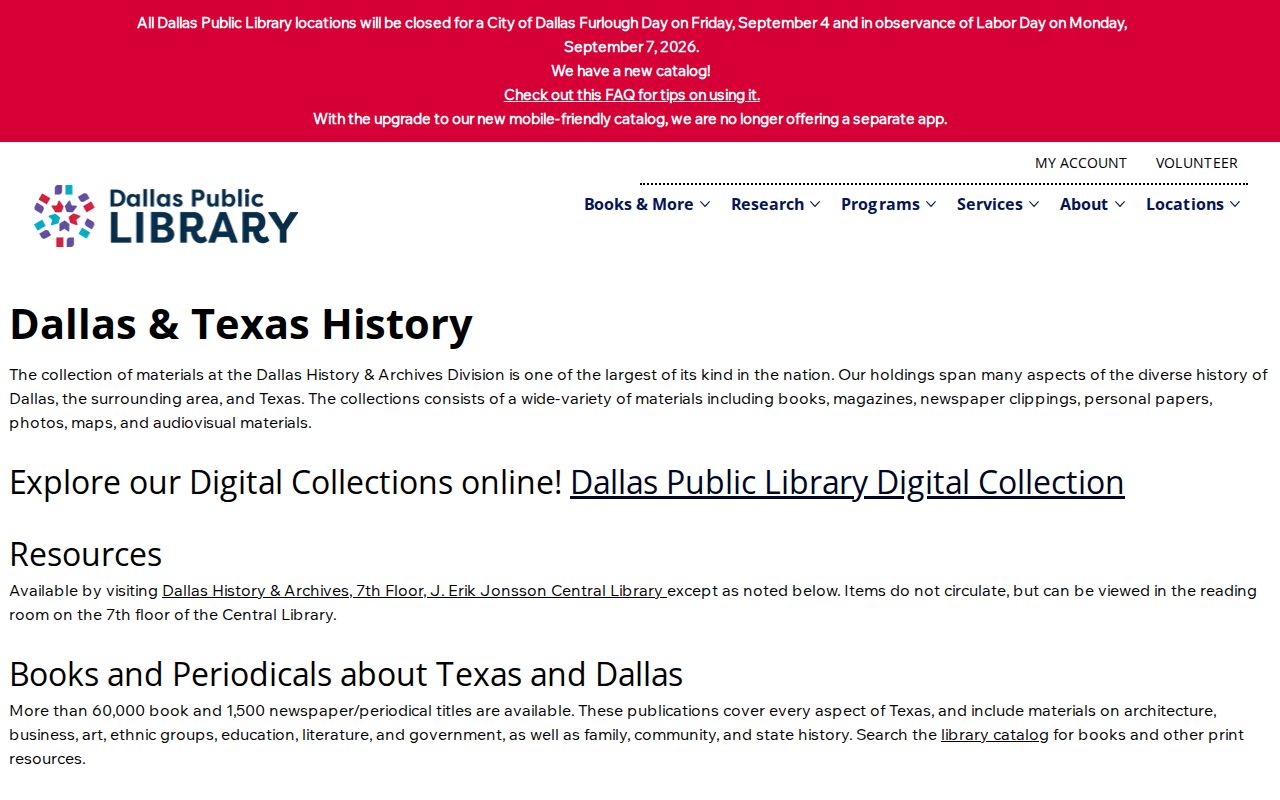
Its map and newspaper holdings make it possible to compare a directory address with a street, lot, or community notice from the same era.
University Park City Directory at SMU
SMU's DeGolyer Library provides a different type of University Park city directory evidence. Its digitized Dallas, Texas, Negro city directory, 1941-1942, Part 2 has related Part 1 and Part 3 records. The collection-level record identifies the title, date range, part, holding institution, digital identifier, and page navigation. Its described contents reach beyond names and addresses to schools, churches, teachers, officials, businesses, photographs, and advertisements.
No individual page-level person entry was captured in the research. Transcribe a name only after opening the item image and preserving the spelling, address, role or notation, page number, and the volume's abbreviation key. That procedure matters when a spelling difference or an abbreviated line may change the person being traced.
Open the SMU Part 2 item to inspect the digital collection before using the image.
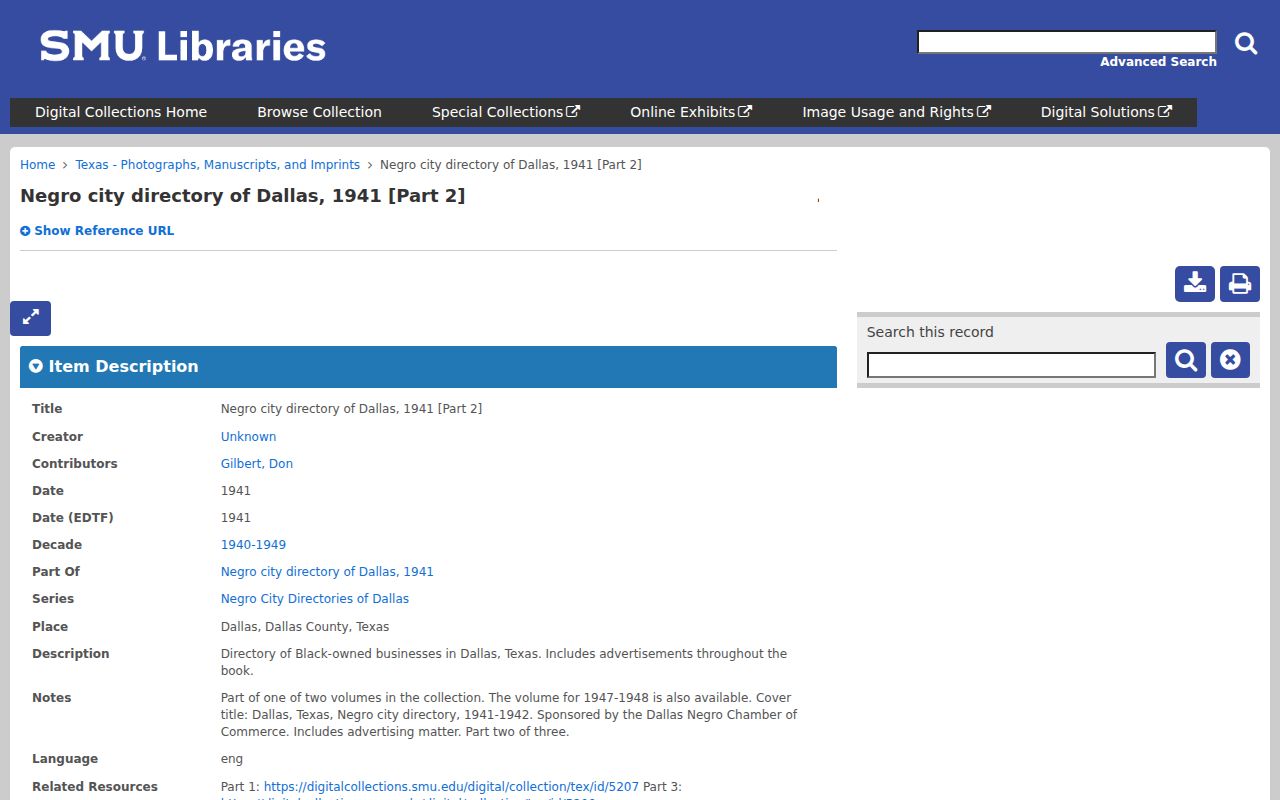
For onsite special-collections work, DeGolyer is at 6404 Robert S. Hyer Lane; appointments are recommended, and the library lists 214-768-3637 and degolyer@smu.edu for contact.
Reading a University Park City Directory Entry
A historical entry is compact. It may identify a surname and given name, spouse or household notation, occupation or business, employer or firm, street address, owner or renter mark, widow status, and a telephone number in phone-book eras. Which fields appear depends on the title and year. The evidence is a dated listing, not a statement that the person owned the place or lives there now.
| Name line | Spelling, initials, suffixes, and spouse or household notation can distinguish similar names. |
|---|---|
| Address | A street number and street name identify the listing's reported location for that edition. |
| Work line | An occupation, business, employer, or firm can help separate people with the same name. |
| Status mark | Owner or renter marks and widow notation are title-specific clues, not legal conclusions. |
| Telephone line | A number may appear in telephone eras, while unlisted subscribers can be absent. |
- Criss-cross directory
- An address-first directory section that moves from a street and number to the listed name or household.
- Householder index
- A name index focused on household heads, which may leave other people at the address unlisted.
- Abbreviation key
- The volume's guide to its shortened terms and symbols. Photograph or note it before interpreting a line.
Note: Keep the entry's edition year with every transcription because the same address can carry a different listing in the next volume.
University Park Cross-Reference Directories
Dallas Cross Reference no. 193 is the key University Park city directory route when the address comes first. DPL lists runs for 1936, 1940, 1944-45, 1951-59, 1961, 1963-79, and later listed ranges through 2019. The separate Park Cities telephone directory, no. 549, covers 1970, 1981, and listed periods from 1988 through 2010. No. 779 supplies a 1997 Highland Park/University Park title.
These are useful comparisons, not duplicate proof. A cross-reference volume organizes research from the street toward a listed name, while a name directory begins with the person. Telephone directories may leave out unlisted subscribers. Compare the address spelling, volume date, and notation, then test the result against a deed, map, or newspaper before reaching a conclusion about a household.
Note: A cross-reference result establishes a dated listing at an address, not a complete account of every person in that household.
University Park Directory Place Labels
University Park incorporated in 1924 after Dallas and Highland Park declined annexation. Its first city area was reported as 515 acres with 380 homes and 1,200 residents. That history helps explain why a directory trail can pass through Dallas-wide records, Park Cities titles, and SMU-linked collections rather than a single municipal book.
- 1873: DPL's Dallas City Directory holdings begin, though listed runs include gaps.
- 1905: The library's microfilmed Dallas telephone-directory holdings begin.
- 1924: University Park incorporated, adding a municipal label to a record landscape already tied to Dallas and SMU.
- 1936: DPL lists an early Dallas Cross Reference volume, a useful address-first route.
- 1941-42: SMU's digitized Dallas Negro city directory records a community-specific directory collection.
The library records no verified first University Park-only printed directory or final printed year. That uncertainty is worth preserving. Search both the local name and the broader Dallas-area labels instead of assuming a missing municipal title means a missing person or address.
Trace University Park City Directory Households
Start with the closest city directory year in which the name or address appears. Follow the person forward and backward through available editions, recording exact spelling, street number, and any status mark. For an address-led question, check the cross-reference or Park Cities volume for that year. The directory collections themselves can then be paired with the federal census, released through 1950, to distinguish a time-stamped listing from a fuller household record.
- Locate the first available listing and save its year, spelling, address, and every notation.
- Check the nearest earlier and later volumes for a move, a new spouse notation, or a changed address.
- Use the cross-reference section to read the address from the street side where a suitable volume exists.
- Pair the directory year with the closest released census schedule for household composition and address context.
- Use a deed, map, or newspaper to test a move, death, sale, or neighborhood change suggested by the listings.
A disappearance can mean a move, a death, a change in listing practice, or simple omission. Dallas Morning News access through DPL covers 1885-1984 online with library access, and microfilm offers another route. The Bockstruck Genealogy Collection on the eighth floor adds family files, Family Bibles, microform, and FamilySearch Affiliate computers when a directory trail needs supporting evidence.
University Park Directory Maps and News
The Bockstruck Genealogy Collection supports directory research with family files, microform, county and state books, and FamilySearch Affiliate access. It is a research collection, not a current contact list. Its surname index can point toward archival material, while newspapers, cemetery records, probate indexes, and family sources can help confirm a transition suggested by a directory.
Review the linked Dallas genealogy collection page before the image below.
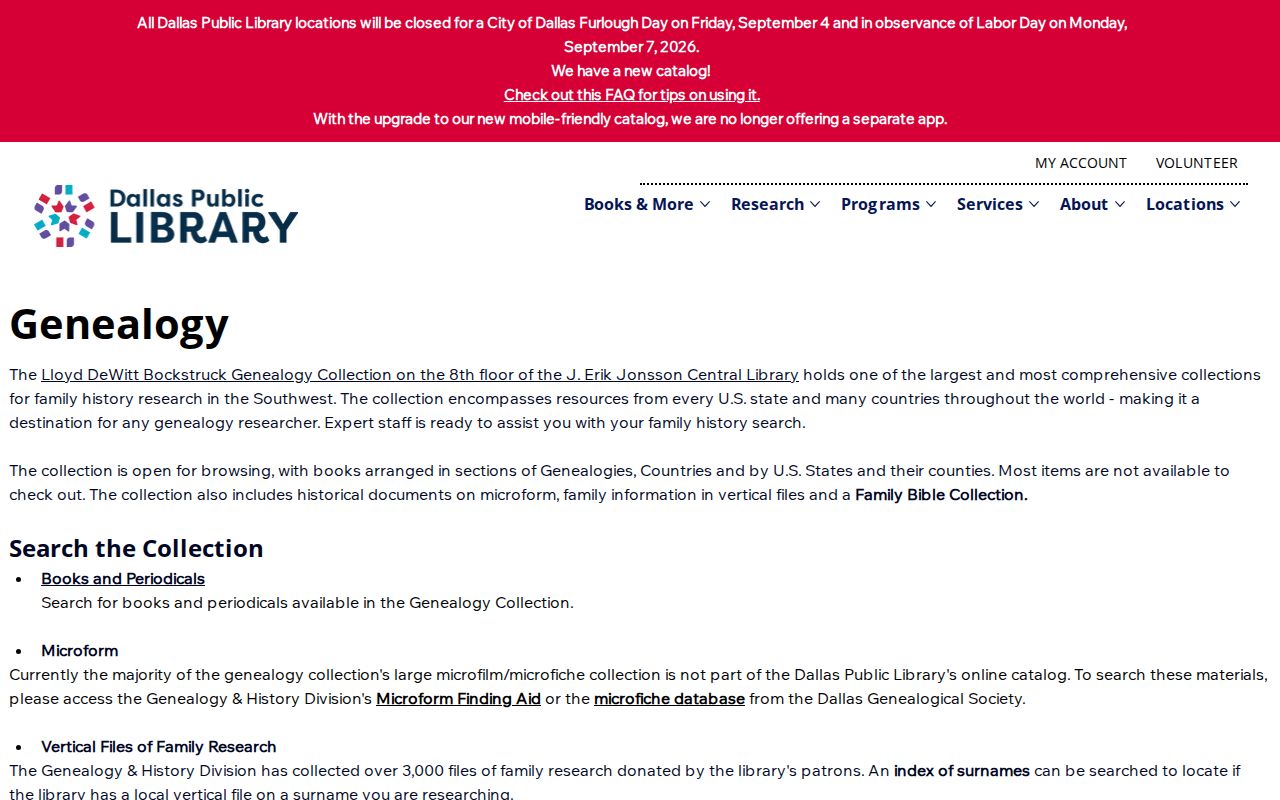
For older lot research, DPL's historic-building guide points to early Dallas directories and a 1901 street listing. University Park Public Library's online resources list includes local genealogy and newspaper options. Murphy & Bolanz block and addition books for 1880-1920 are online through DPL Recollect, while Sanborn coverage must be checked sheet by sheet for the University Park block at issue.
University Park Archive Access Options
When the DPL shelf and SMU item leave a gap, Dallas Historical Society's G.B. Dealey Library offers an appointment-only Dallas, Dallas County, and Texas collection. It is open by appointment Tuesday through Friday from 10 a.m. to 4 p.m. The society answers email questions for about fifteen minutes without charge; deeper research is fee-based and reproductions need staff approval. That service can help locate finding aids, photographs, documents, books, and periodicals tied to a directory trail.
Use the collection rather than guessing. A directory line becomes stronger when the date, place label, map, newspaper notice, and public record agree. It remains a historical research lead, never a complete roster of everyone who lived at an address.
Note: Archive appointments and targeted questions are useful when a directory title, map sheet, or newspaper issue is not available online.